Slovakia TechnologyInvestments

Group and portfolio

We own and run technology businesses.

STI's investments are not only financial. Our two operating companies provide the engineering, software and research capacity we put to work in our investments, licences and restarts. Their role is agreed for each opportunity.
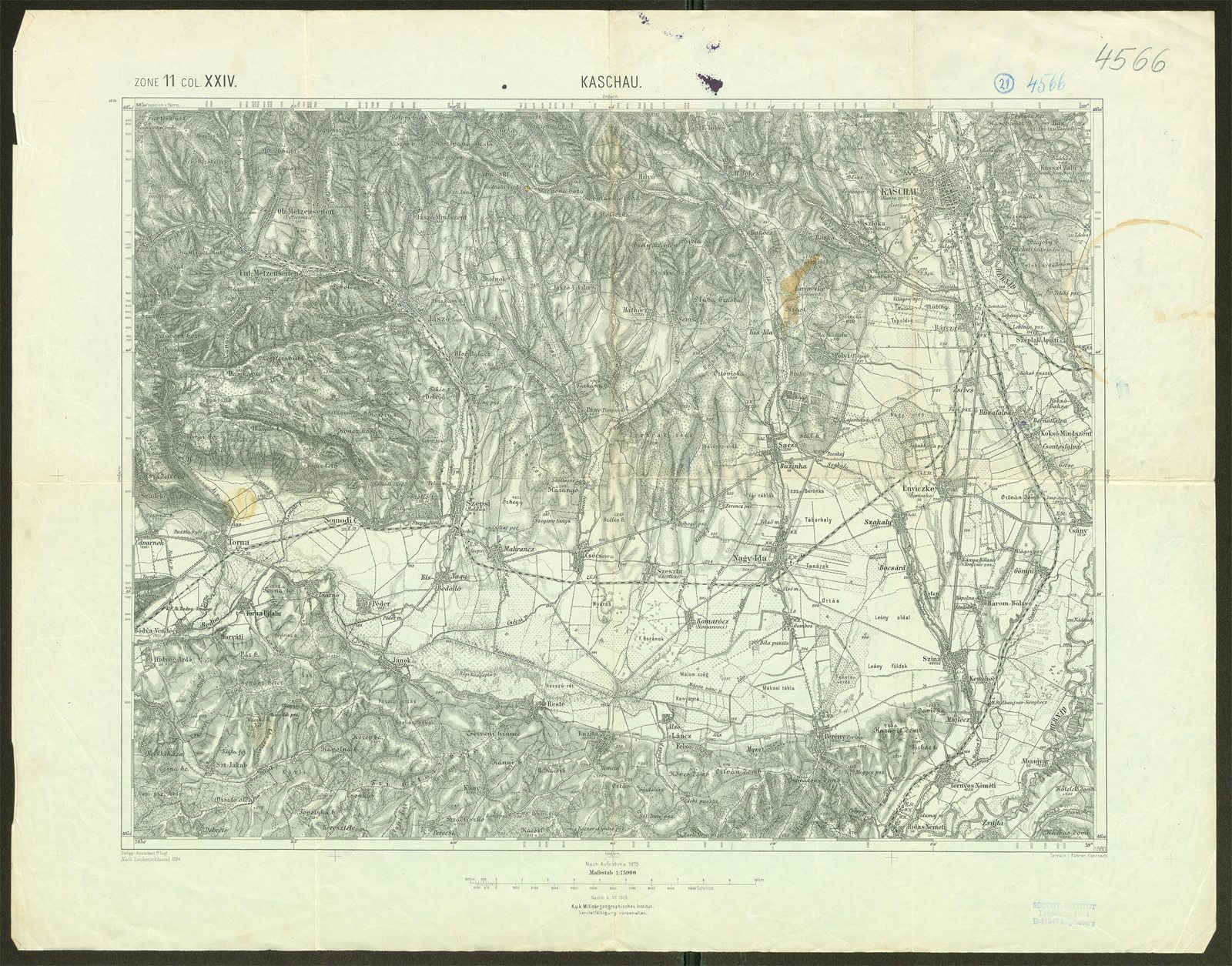
Topographic map of Košice and its surroundings from 1909
Slovakia Technology Investments a.s.Investment · IP · special situations · EU projects · Košice
51% · industrial engineering

Industry & Project Engineering s.r.o.

Michalovce, Slovakia

100% · applied R&D

Slovakia Supercomputers s.r.o.

Košice · certified R&D entity

Development project

NaturePack EO

Developed within STI; not a separate company

Holdings as of October 2026. The group had about 26 people in 2025 (aggregated figure from STI's EU SME self-assessment of 22 June 2026).

51% · industrial engineering

Industry & Project Engineering s.r.o.

A design and engineering company for the chemical, metallurgical, water and energy, petroleum, pharmaceutical and food industries: calculations, process design, construction documentation and implementation.

Its published project examples include a chrome-free passivation line, a resin production plant, the dismantling of a cyclohexanone production facility, laser-scan modelling of existing plants, and the reactivation and re-instrumentation of an idle refinery – the kind of work needed to bring stopped installations back into service.

Role in STI's work: technical assessment of industrial assets, industrialisation and scale-up, restart planning for equipment and lines.
See IPE's published work

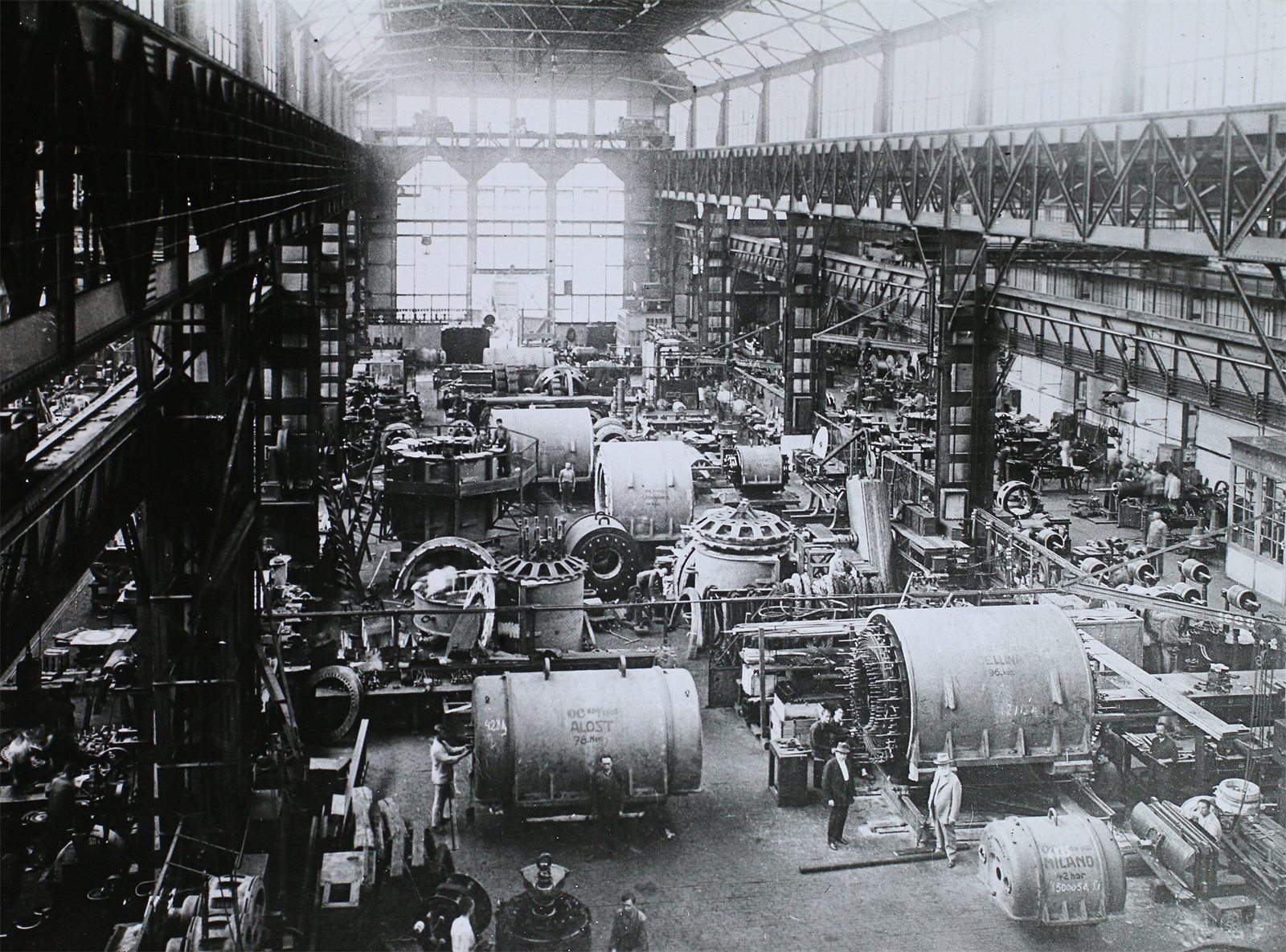
Historic photograph of a large engineering works hall with generators under assembly, 1922
Engineering heritage of the region: generator assembly at the Ganz works, Budapest, 1922. Not an STI facility.

At a glance

  • Michalovce, eastern Slovakia
  • 51% owned by STI
  • Engineering for process industries
  • Brownfield, revamp and restart experience
100% · applied R&D

Slovakia Supercomputers s.r.o.

An applied technology company working on AI and data analysis for industry, web information systems, embedded systems and industrial IoT, measurement and control systems, and 3D visualisation and VR simulators. It is certified by the Slovak Ministry of Education as an entity able to carry out research and development.

Role in STI's work: review and takeover of software, code and data; completing prototypes; AI and IoT work for industrial pilots; R&D partner in EU projects.

Visit Slovakia Supercomputers

At a glance

  • Košice, Slovakia
  • 100% owned by STI
  • Certified R&D entity (Slovak Ministry of Education)
  • AI · IoT · embedded systems · 3D/VR
Development project

NaturePack EO

Development project · not yet a commercial product

NaturePack EO explores an active-packaging sachet for fresh fruit and vegetables, using plant essential oils encapsulated in β-cyclodextrin and released slowly in the vapour phase inside the packaging. The aim is to reduce spoilage and post-harvest losses with a natural alternative to synthetic preservatives.

The planned research will assess release behaviour, antimicrobial performance, packaging compatibility, safety and regulatory requirements for selected produce. In June 2026 STI submitted, as sole applicant, a proposal to an EU-funded open call for validation in real-life test environments; it is under evaluation (status: October 2026).

Painting of a summer river landscape with fields and hills near Košice
Summer landscape near Košice, painted around 1920. Fresh produce from the region is what NaturePack EO aims to protect.

Possible applications

  • Pears, apples, kiwi fruit, berries
  • Tomatoes, peppers, onions, carrots
  • Leafy vegetables and fresh herbs
  • Storage, transport and retail packaging

About this presentation. NaturePack EO is a development project within STI and is not yet a commercial product. The presentation brings together research and validation evidence, the planned product, and the route to pilots and market entry. Safety and performance statements refer to the ingredients, formulations, produce and test conditions described; product-specific safety and regulatory assessment remains part of the development programme.

NaturePack EO presentation

The project presentation, in English. Select a slide to enlarge it.
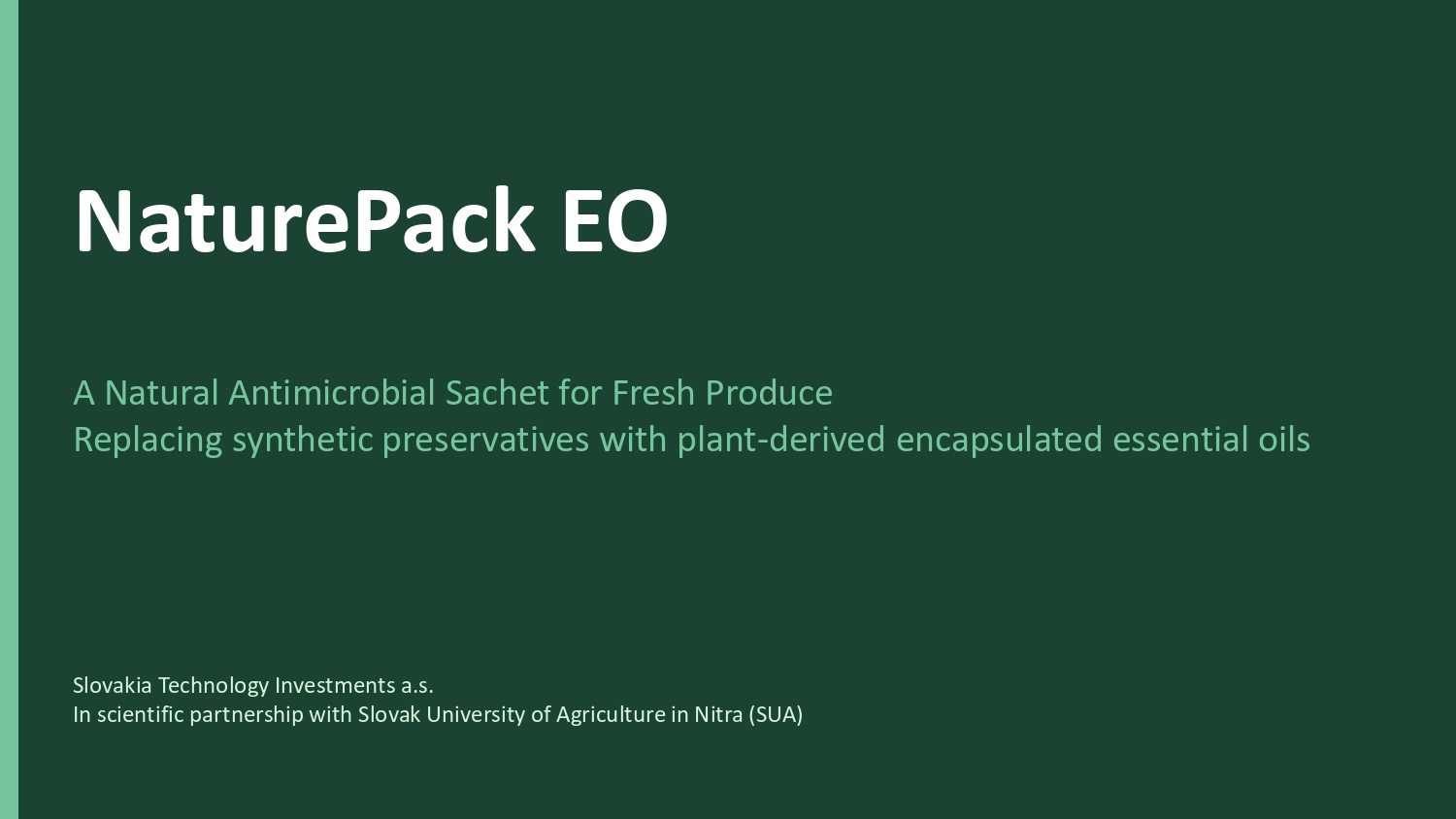
Text of the slides
  1. 1 · NaturePack EO

    A Natural Antimicrobial Sachet for Fresh Produce. Replacing synthetic preservatives with plant-derived encapsulated essential oils. Slovakia Technology Investments a.s. In scientific partnership with Slovak University of Agriculture in Nitra (SUA).

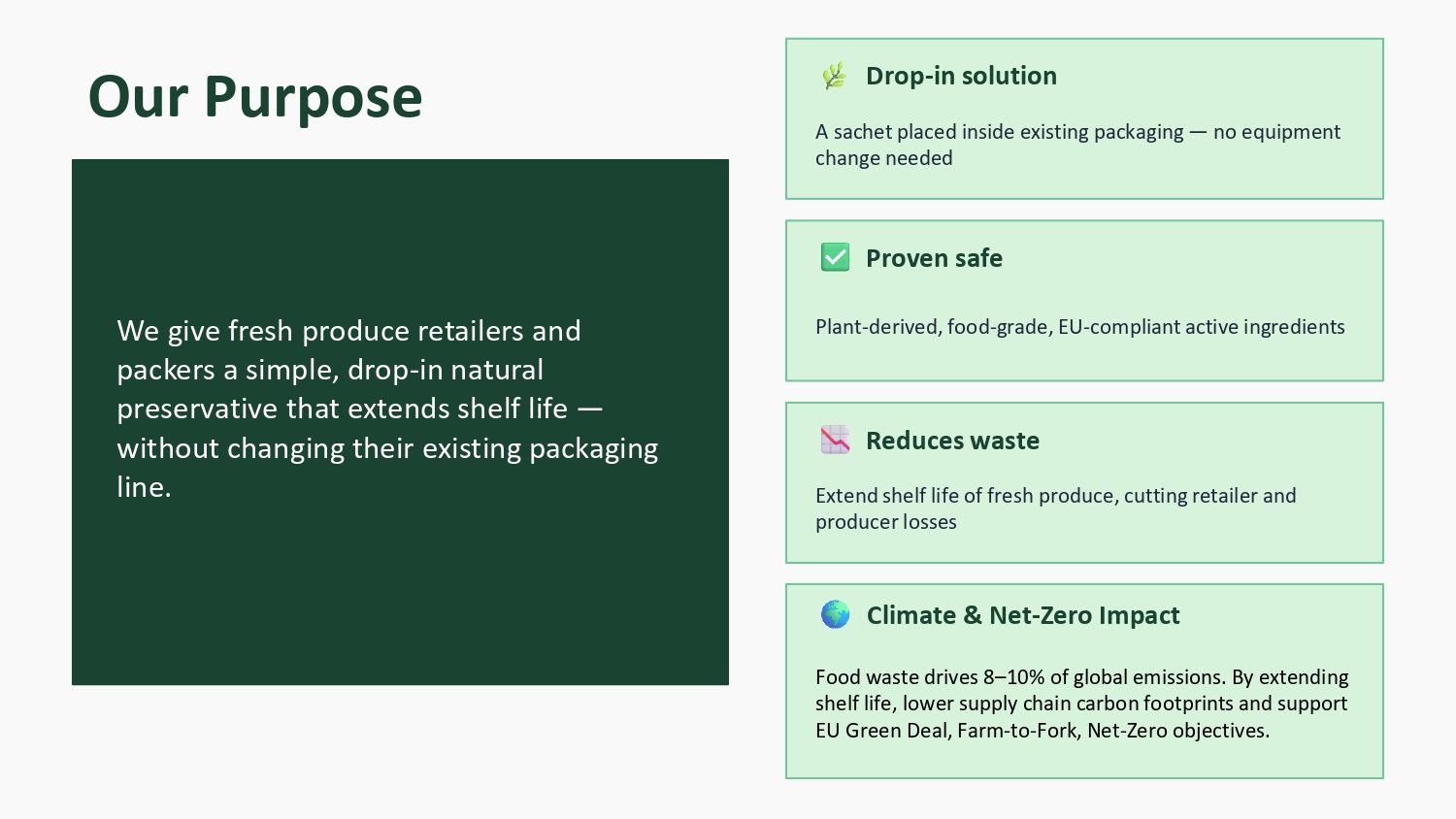
  2. 2 · Our Purpose

    We give fresh produce retailers and packers a simple, drop-in natural preservative that extends shelf life — without changing their existing packaging line.

    • Drop-in solution: a sachet placed inside existing packaging — no equipment change needed.
    • Food-grade basis: plant-derived ingredients with established food uses.
    • Reduces waste: extends shelf life of fresh produce, cutting retailer and producer losses.
    • Climate & Net-Zero Impact: food loss & waste cause 8–10% of global emissions. Longer shelf life cuts supply-chain carbon footprints and supports EU Green Deal, Farm to Fork, net-zero objectives.
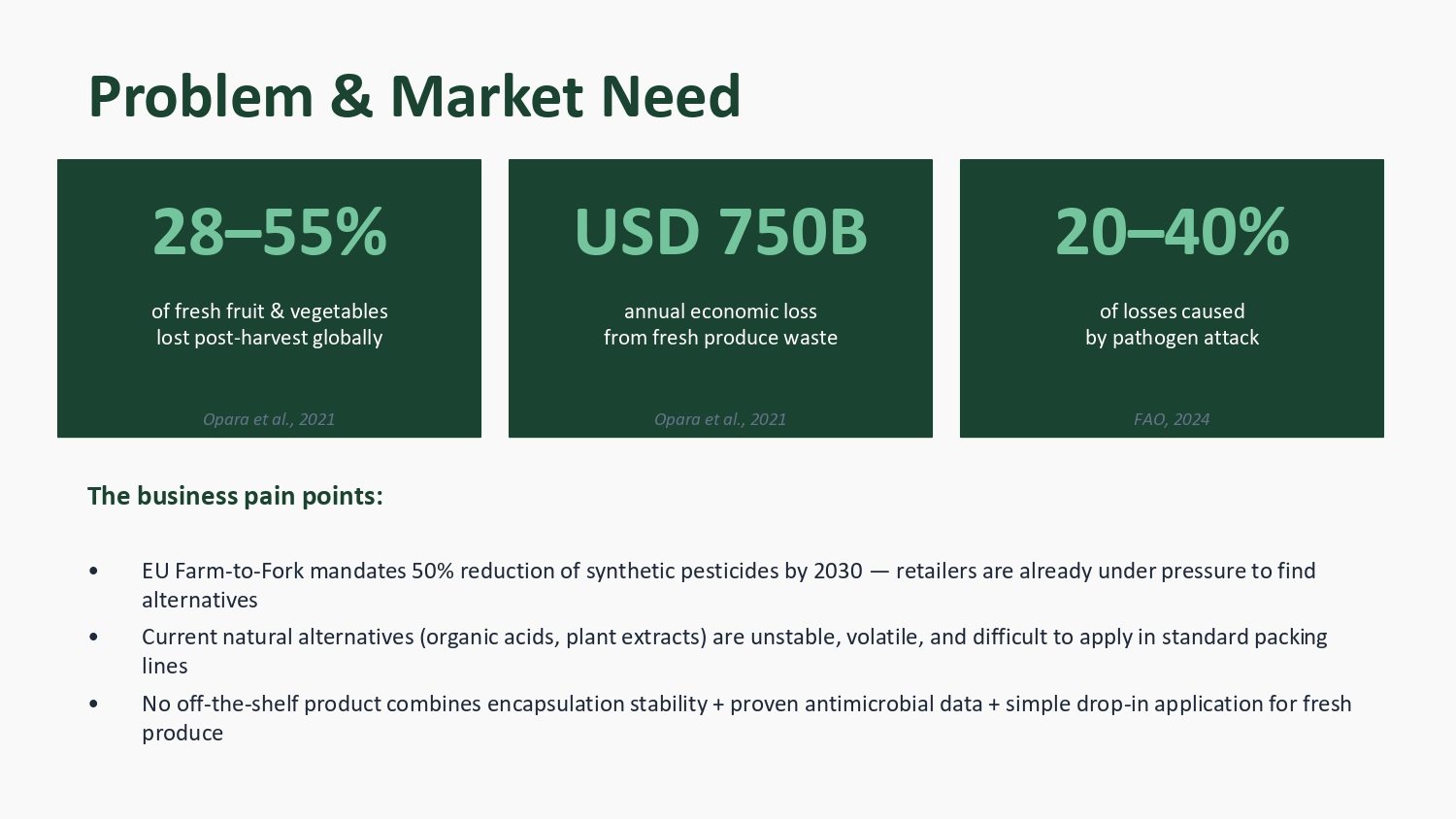
  3. 3 · Problem & Market Need

    • 28–55% of fresh fruit & vegetables lost post-harvest globally (Opara et al., 2021).
    • USD 750B annual economic loss from fresh produce waste (Opara et al., 2021).
    • 20–40% of losses caused by pathogen attack (FAO, 2024).

    The business pain points:

    • The EU Farm to Fork Strategy targets a 50% cut in the use and risk of chemical pesticides by 2030 — retailers are already under pressure to find alternatives.
    • Current natural alternatives (organic acids, plant extracts) are unstable, volatile, and difficult to apply in standard packing lines.
    • No off-the-shelf product combines encapsulation stability + published antimicrobial data + simple drop-in application for fresh produce.
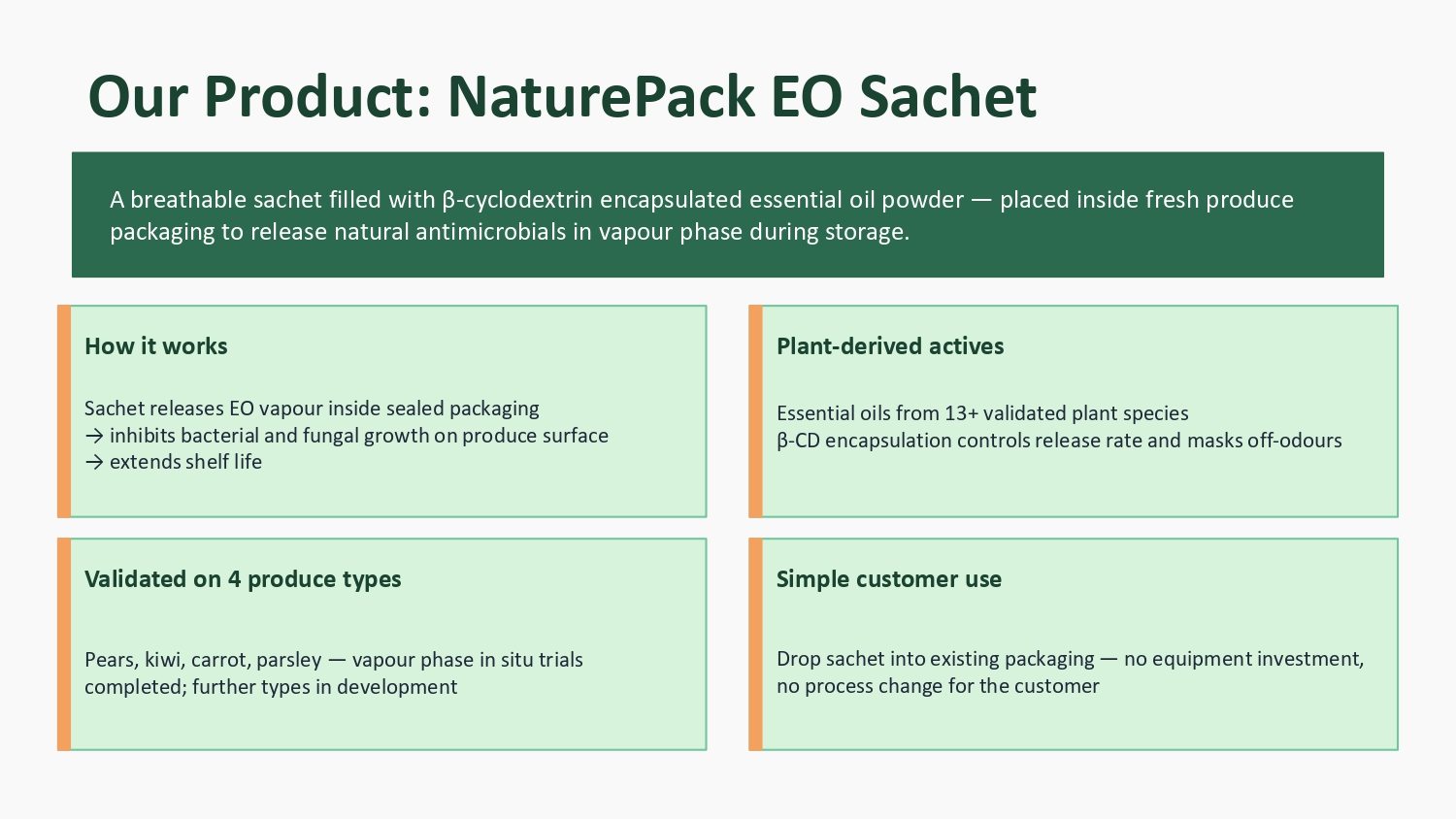
  4. 4 · Our Product: NaturePack EO Sachet

    A breathable sachet filled with β-cyclodextrin encapsulated essential oil powder — placed inside fresh produce packaging to release natural antimicrobials in vapour phase during storage.

    • How it works: sachet releases EO vapour inside sealed packaging → inhibits bacterial and fungal growth on produce surface → extends shelf life.
    • Plant-derived actives: essential oils from 13+ plant species, lab-tested; β-CD encapsulation controls release rate and masks off-odours.
    • Validated on 4 produce types: pears, kiwi, carrot, parsley — vapour phase in situ trials completed; further types in development.
    • Simple customer use: drop sachet into existing packaging — no equipment investment, no process change for the customer.
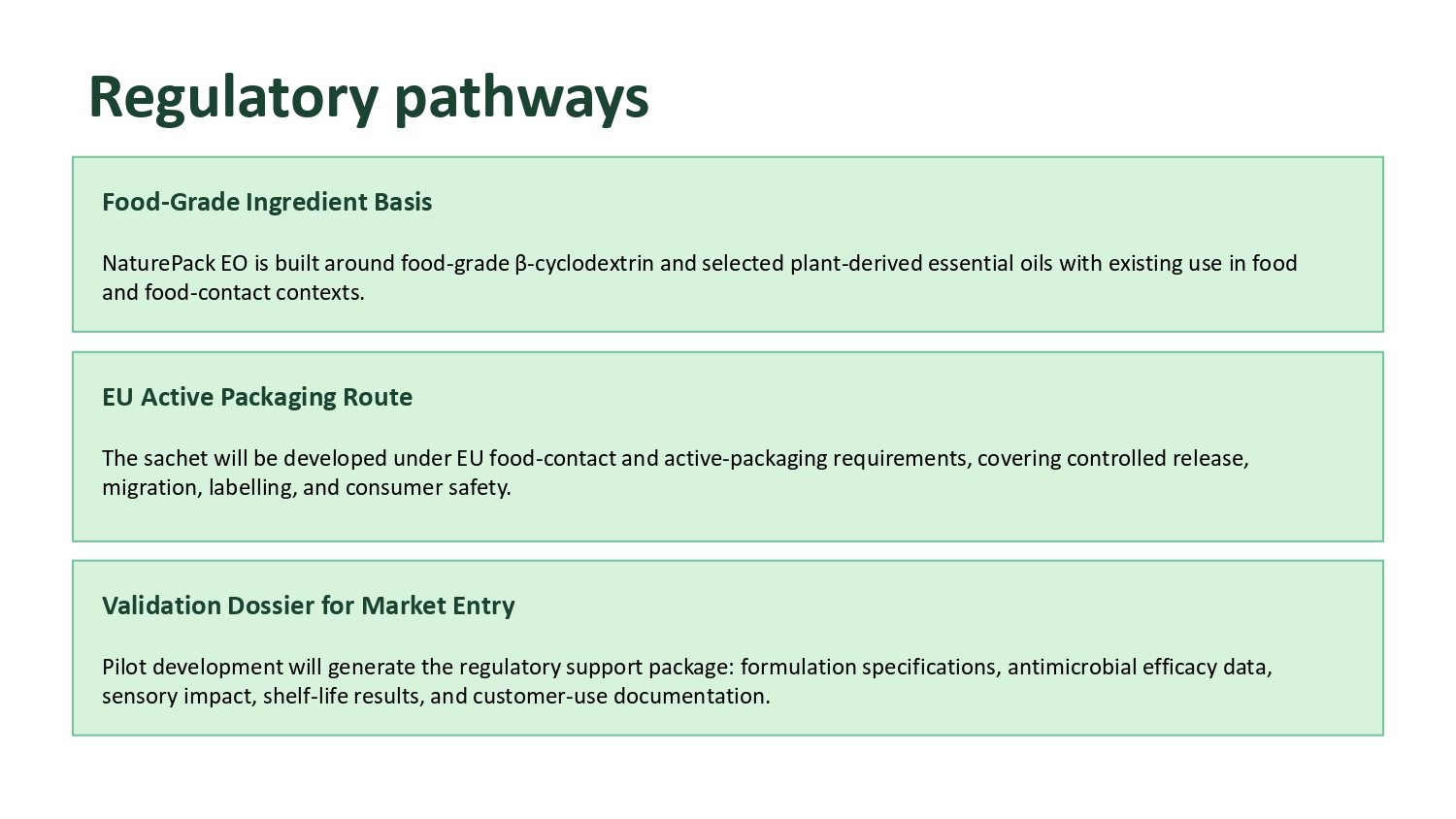
  5. 5 · Regulatory Pathways

    • Food-Grade Ingredient Basis: NaturePack EO is built around food-grade β-cyclodextrin and selected plant-derived essential oils with existing use in food and food-contact contexts.
    • EU Active Packaging Route: the sachet will be developed under EU food-contact and active-packaging requirements, covering controlled release, migration, labelling, and consumer safety.
    • Validation Dossier for Market Entry: pilot development will generate the regulatory support package: formulation specifications, antimicrobial efficacy data, sensory impact, shelf-life results, and customer-use documentation.
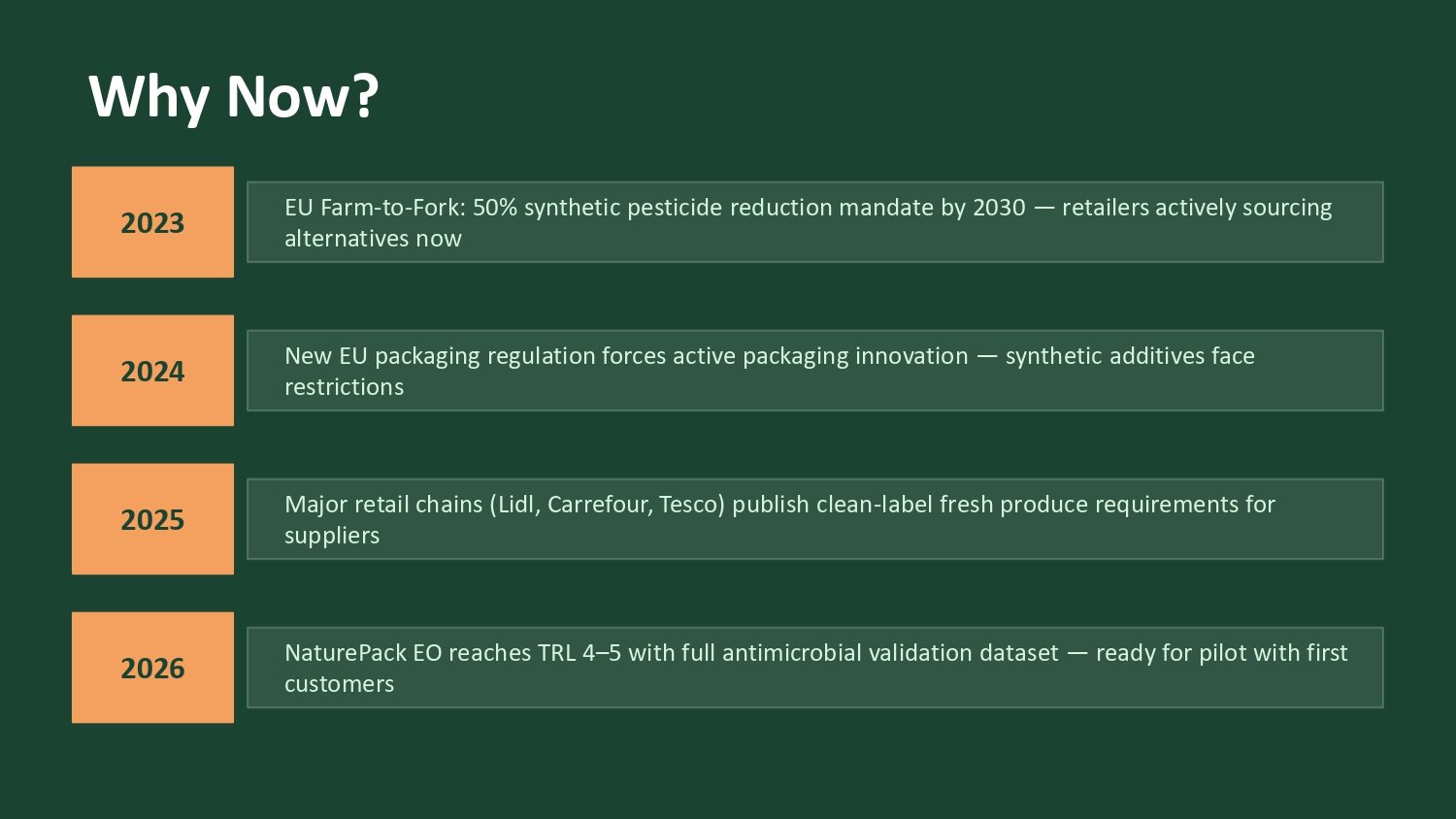
  6. 6 · Why Now?

    • 2020: EU Farm to Fork Strategy sets a target to cut the use and risk of chemical pesticides by 50% by 2030 — retailers are looking for alternatives.
    • 2025: New EU Packaging and Packaging Waste Regulation (EU) 2025/40 tightens rules for food-contact packaging, including PFAS limits from August 2026.
    • 2025: Major EU retail chains tighten clean-label and residue requirements for fresh produce suppliers.
    • 2026: NaturePack EO reaches TRL 4 with a laboratory antimicrobial dataset — ready for pilots with first customers.
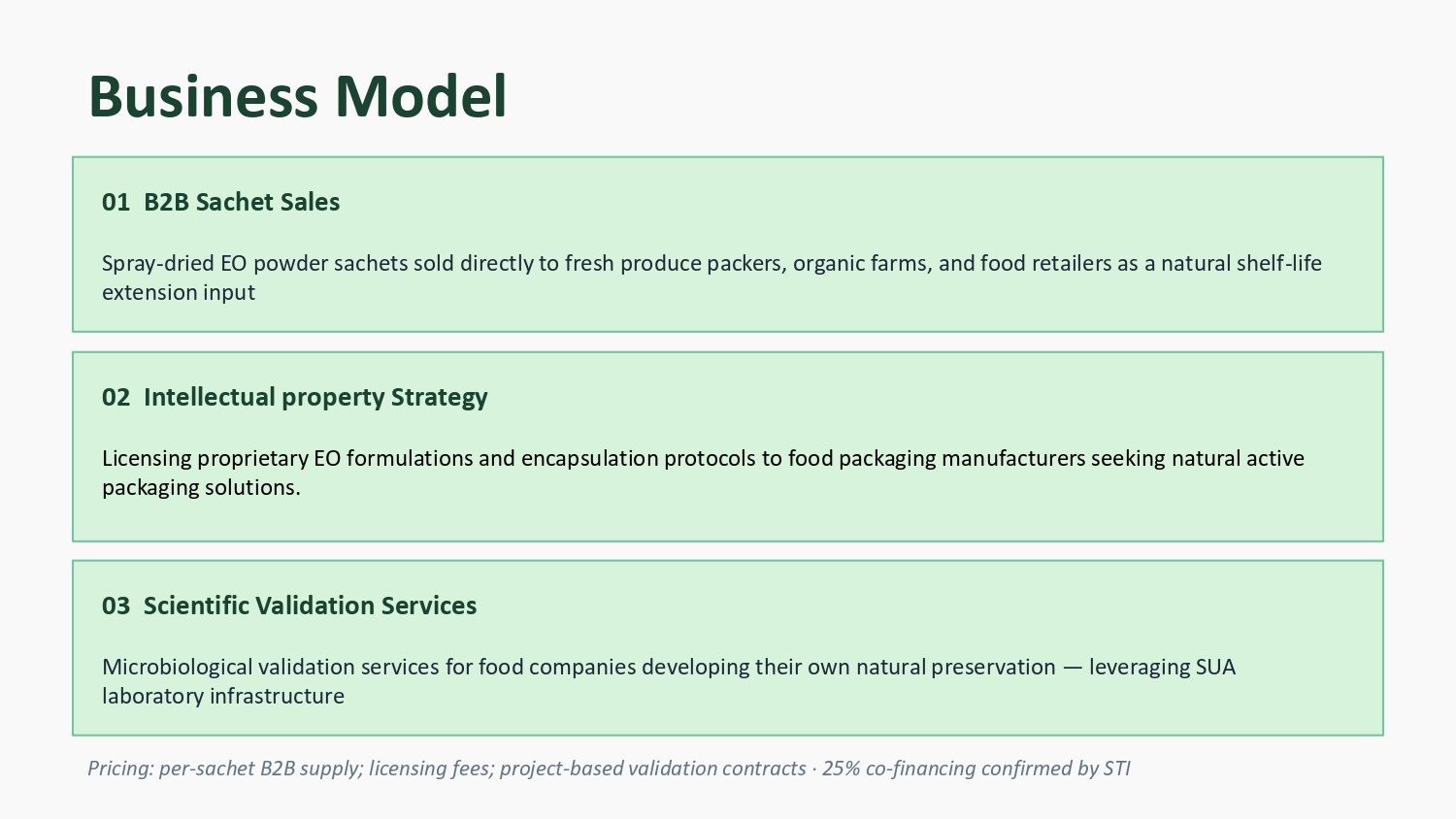
  7. 7 · Business Model

    • 01 B2B Sachet Sales: spray-dried EO powder sachets sold directly to fresh produce packers, organic farms, and food retailers as a natural shelf-life extension input.
    • 02 Intellectual Property Strategy: licensing NaturePack EO know-how to food packaging manufacturers seeking natural active packaging solutions.
    • 03 Scientific Validation Services: microbiological validation services for food companies developing their own natural preservation — with partner laboratories.

    Pricing: per-sachet B2B supply; licensing fees; project-based validation contracts.

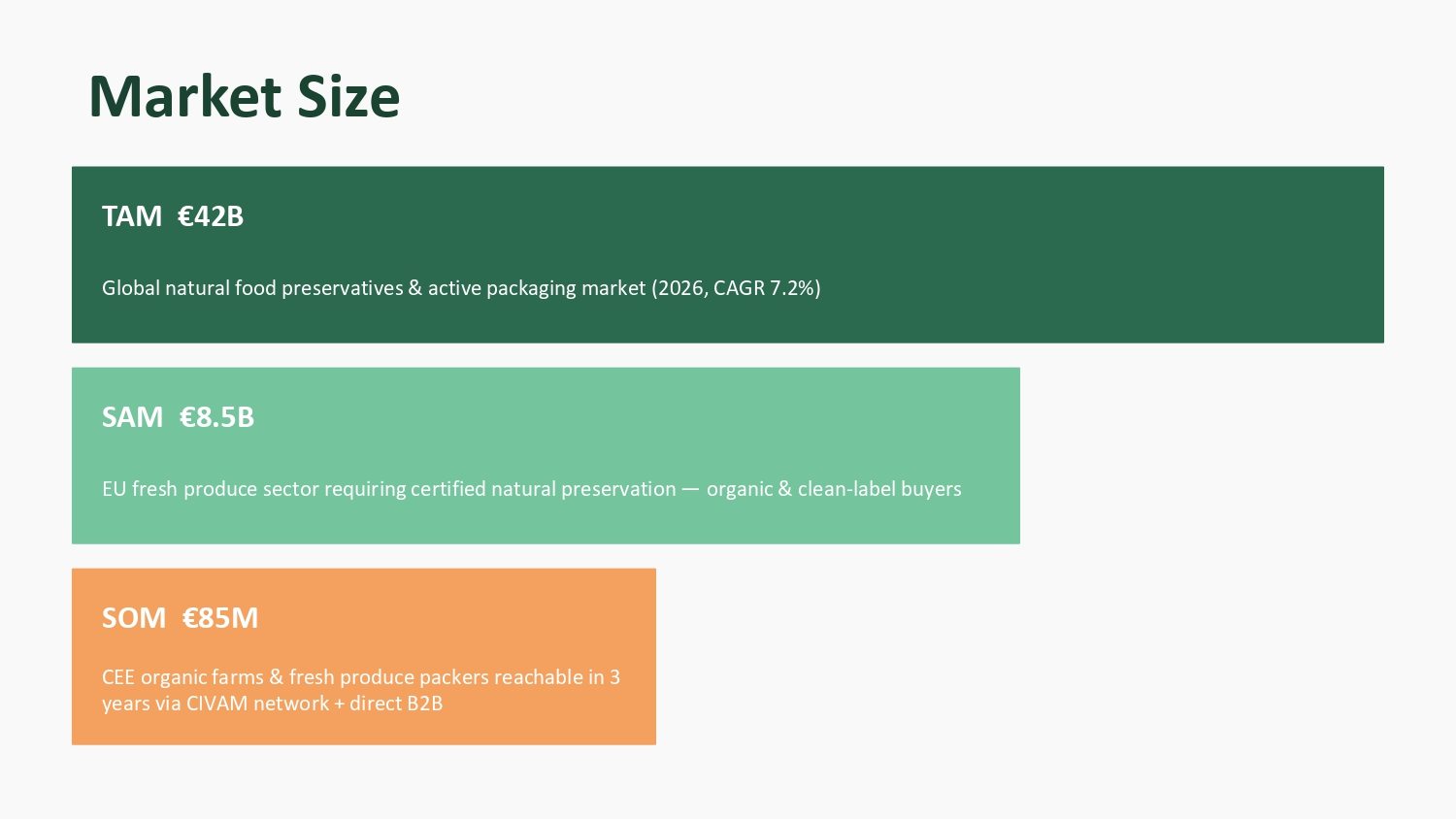
  8. 8 · Market Size

    • TAM €42B: global natural food preservatives & active packaging market (2026, CAGR 7.2%).
    • SAM €8.5B: EU fresh produce sector seeking natural preservation — organic & clean-label buyers.
    • SOM €85M: CEE organic farms & fresh produce packers reachable in three years via direct B2B and producer networks.
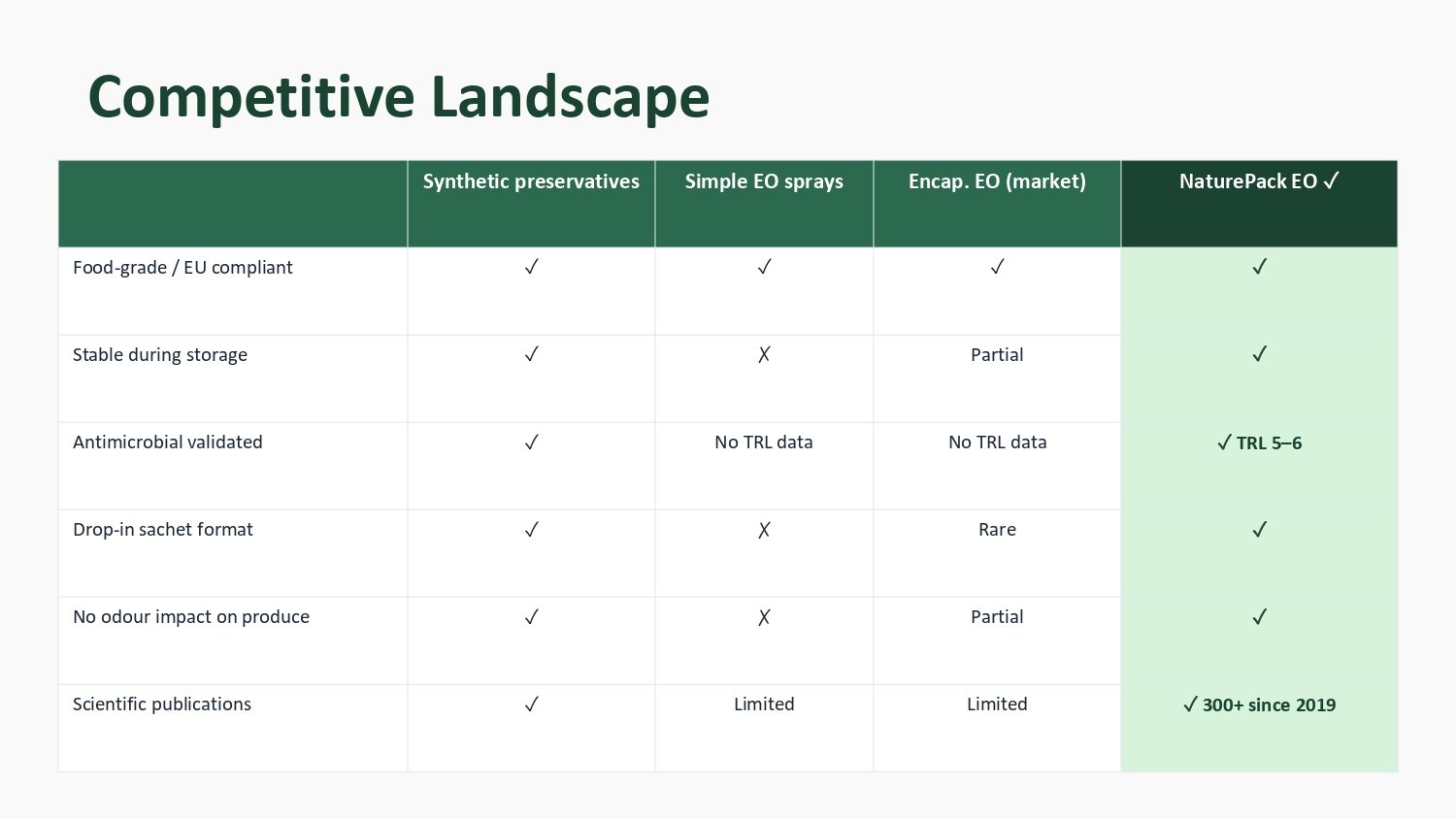
  9. 9 · Competitive Landscape

    Compared: synthetic preservatives / simple EO sprays / encapsulated EO (market) / NaturePack EO.

    • Food-grade ingredients: ✓ / ✓ / ✓ / ✓
    • Stable during storage: ✓ / ✗ / partial / ✓
    • Antimicrobial validated: ✓ / variable / variable / ✓ TRL 4
    • Drop-in sachet format: ✓ / ✗ / rare / ✓
    • No odour impact on produce: ✓ / ✗ / partial / ✓
    • Publications (scientific team): ✓ / limited / limited / ✓ 300+ by partner since 2019
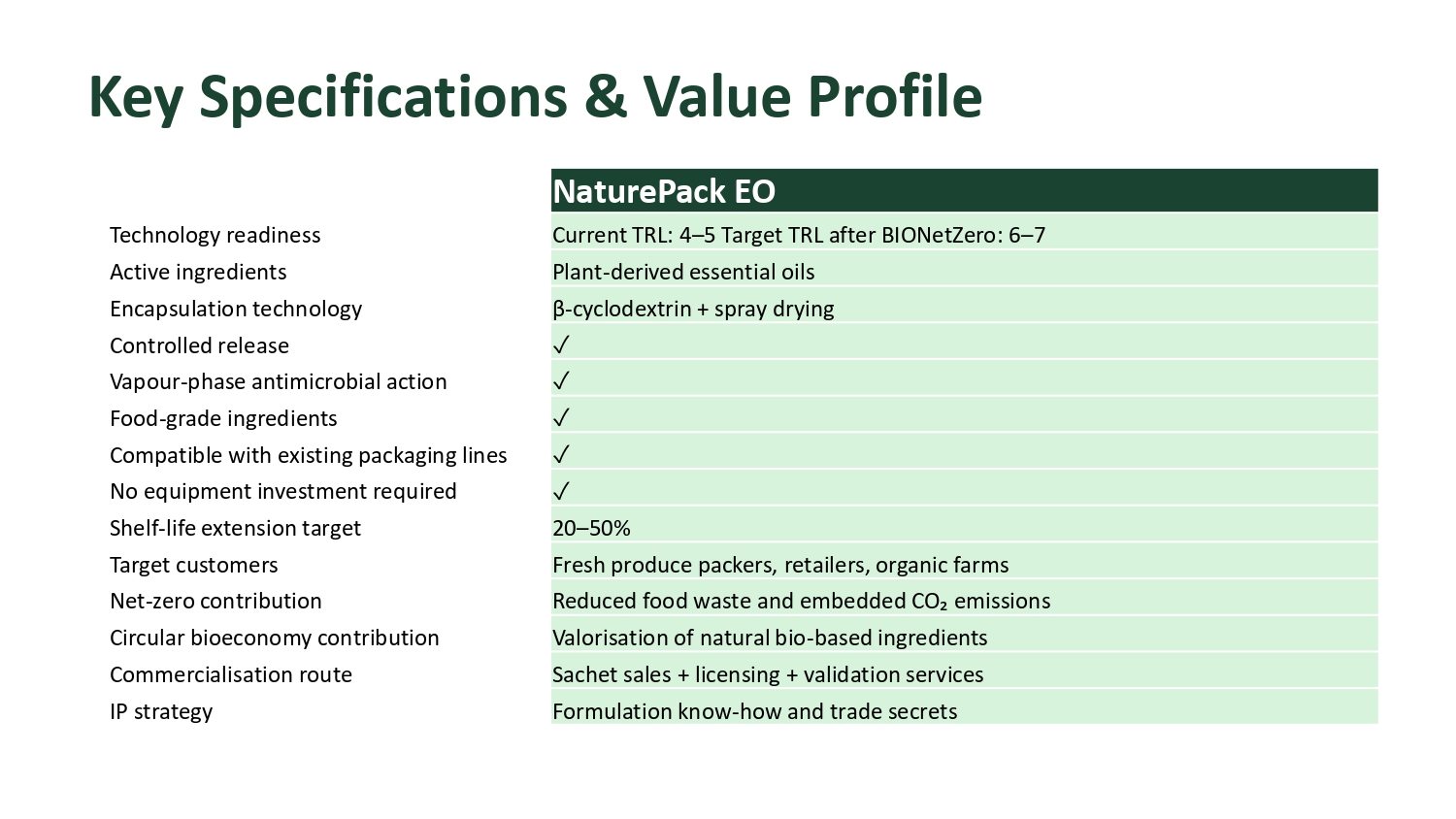
  10. 10 · Key Specifications & Value Profile

    • Technology readiness: current TRL 4; target TRL 5 after field pilots.
    • Active ingredients: plant-derived essential oils.
    • Encapsulation technology: β-cyclodextrin + spray drying.
    • Controlled release; vapour-phase antimicrobial action; food-grade ingredients; compatible with existing packaging lines; no equipment investment required: ✓.
    • Shelf-life extension target: 20–50%.
    • Target customers: fresh produce packers, retailers, organic farms.
    • Net-zero contribution: reduced food waste and embedded CO₂ emissions.
    • Circular bioeconomy contribution: valorisation of natural bio-based ingredients.
    • Commercialisation route: sachet sales + licensing + validation services.
    • IP strategy: formulation know-how and trade secrets.
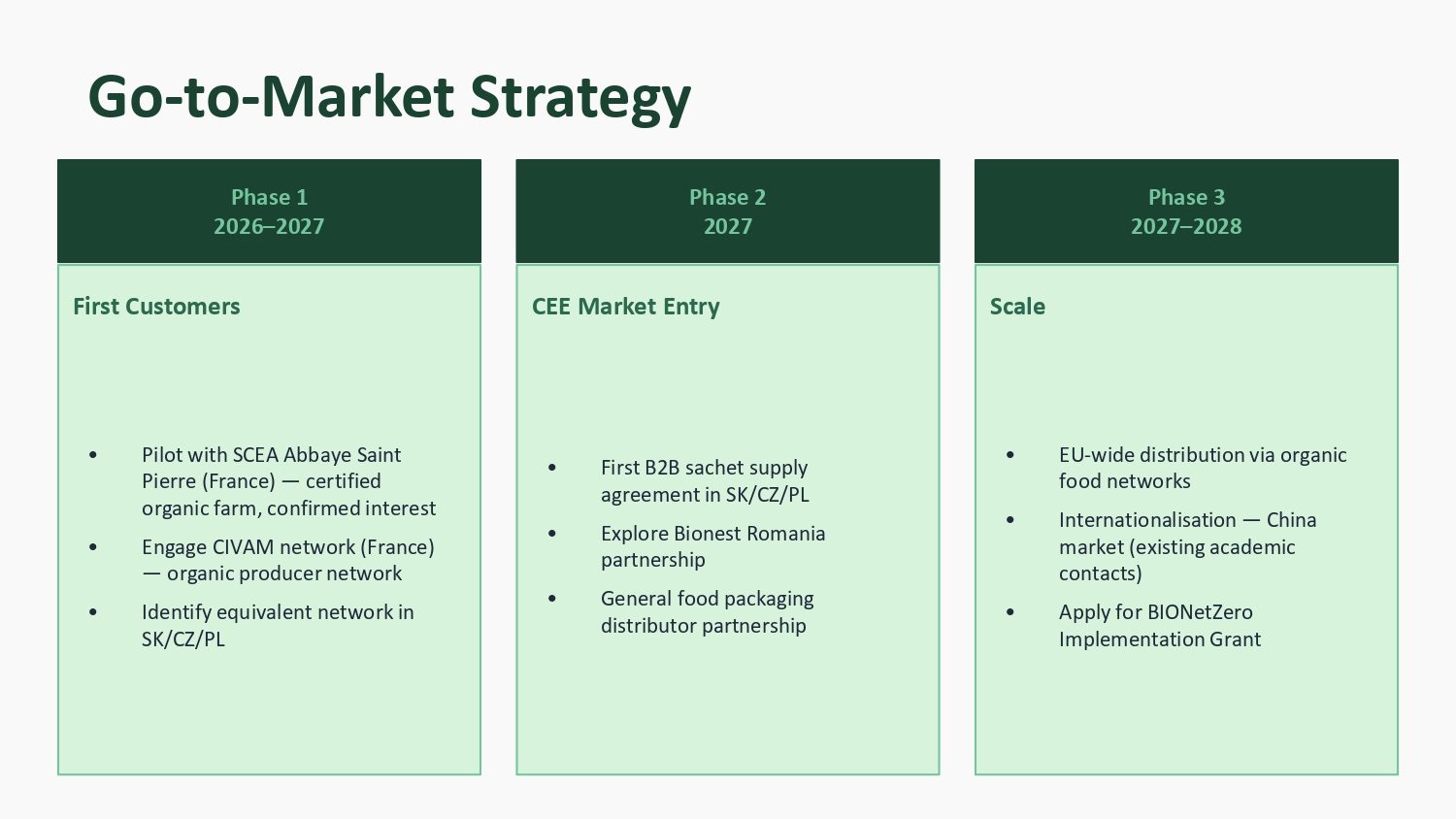
  11. 11 · Go-to-Market Strategy

    • Phase 1, 2026–2027 – First Customers: pilot with SCEA Abbaye Saint-Pierre (France) — certified organic farm, confirmed interest; engage CIVAM network (France) — organic producer network; identify equivalent network in SK/CZ/PL.
    • Phase 2, 2027 – CEE Market Entry: first B2B sachet supply agreement in SK/CZ/PL; explore Bionest Romania partnership; general food packaging distributor partnership.
    • Phase 3, 2027–2028 – Scale: EU-wide distribution via organic food networks; internationalisation — China market (existing academic contacts); feasibility study and field pilots in Kenya.
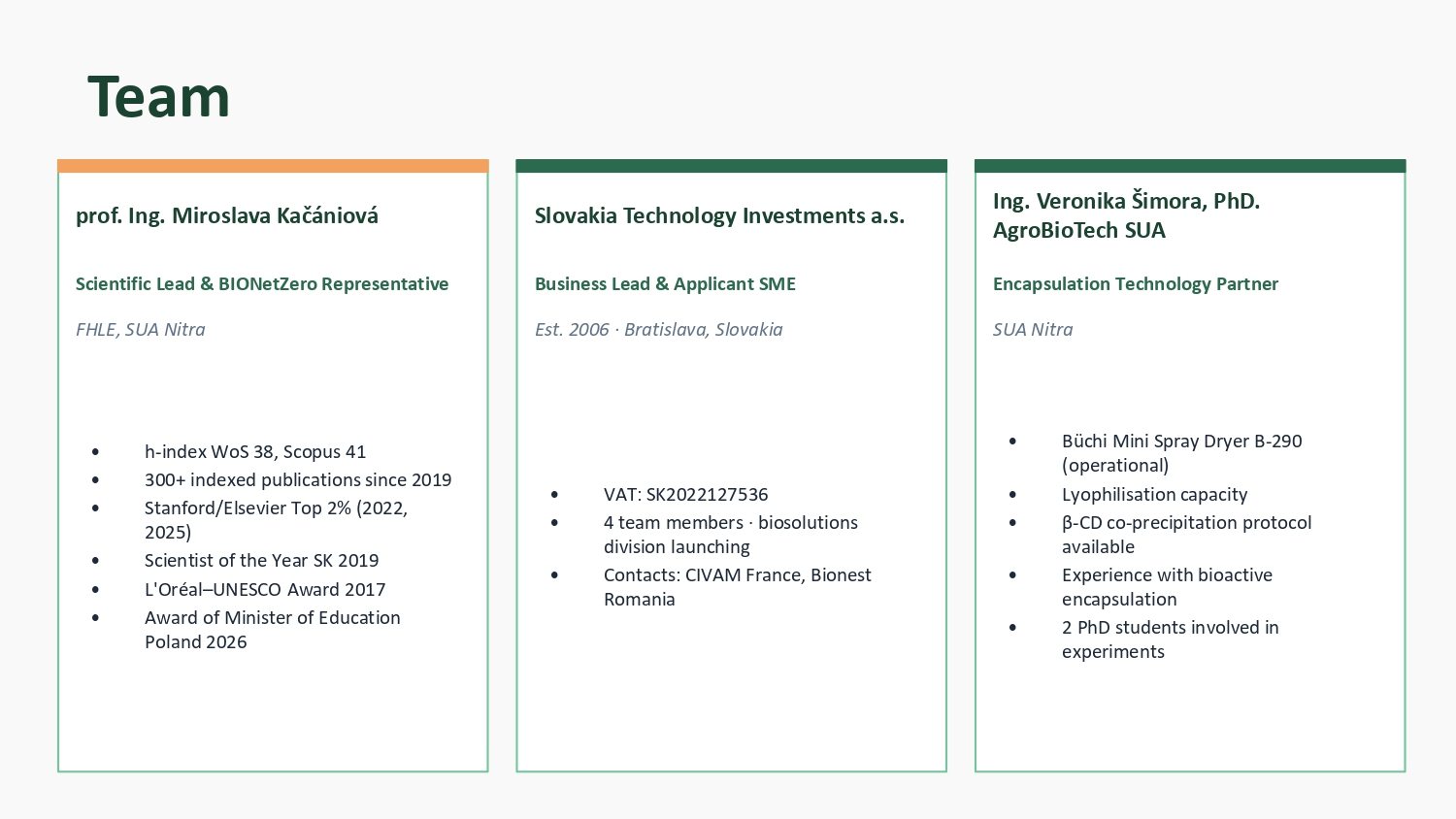
  12. 12 · Team & Research Partners

    • Prof. Ing. Miroslava Kačániová – Antimicrobial Research Partner; FHLE, SUA Nitra. h-index WoS 38, Scopus 41; 300+ indexed publications since 2019; Stanford/Elsevier Top 2% (2022, 2025); Scientist of the Year SK 2019; L'Oréal–UNESCO Award 2017; Award of the Polish Minister of Education, 2026.
    • Slovakia Technology Investments a.s. – Business Lead · Commercialisation; Est. 2006 · Košice, Slovakia. VAT: SK2022127536; 4 team members · biosolutions division launching; contacts: CIVAM France, Bionest Romania.
    • Ing. Veronika Šimora, PhD., AgroBioTech SUA – Encapsulation Technology Partner; SUA Nitra. Büchi Mini Spray Dryer B-290 (operational); lyophilisation capacity; β-CD co-precipitation protocol available; experience with bioactive encapsulation; 2 PhD students involved in experiments.
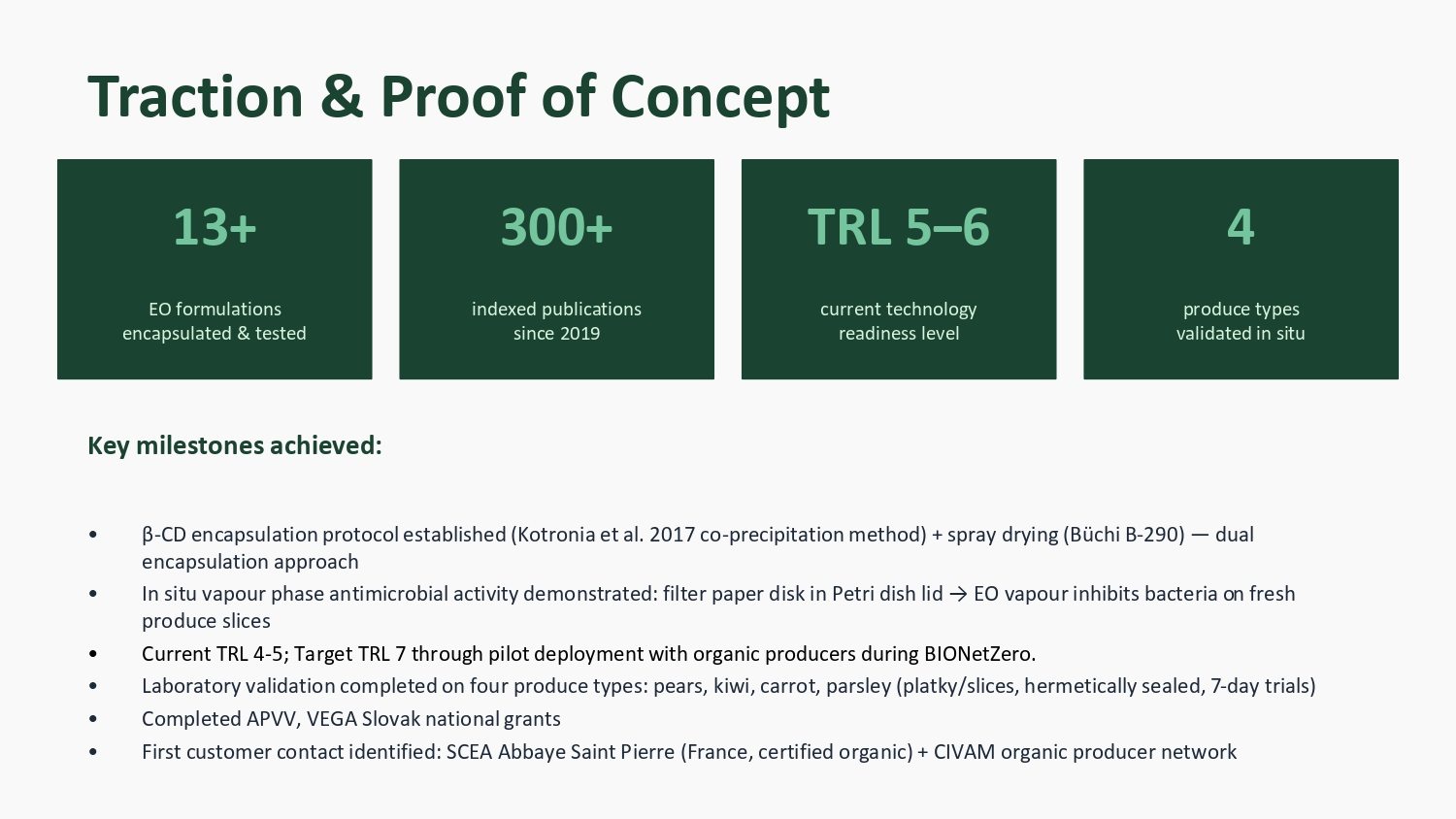
  13. 13 · Traction & Proof of Concept

    • 13+ EO formulations encapsulated & tested.
    • 300+ publications by the research partner since 2019.
    • TRL 4 current technology readiness level.
    • 4 produce types validated in situ.

    Key milestones achieved:

    • β-CD encapsulation protocol established (Kotronia et al. 2017 co-precipitation method) + spray drying (Büchi B-290) — dual encapsulation approach.
    • In situ vapour phase antimicrobial activity demonstrated: filter paper disk in Petri dish lid → EO vapour inhibits bacteria on fresh produce slices.
    • TRL 4 reached in the laboratory; field pilots with packers and organic producers lead to TRL 5.
    • Laboratory validation completed on four produce types: pears, kiwi, carrot, parsley (slices, hermetically sealed, 7-day trials).
    • Builds on SUA's completed APVV and VEGA research projects.
    • First customer contact identified: SCEA Abbaye Saint-Pierre (France, certified organic) + CIVAM organic producer network.

Transcribed from the slides as published; the slide images remain the reference.

What this means for you

STI works across research and industry, structures IP and develops technology with its own people. That is the capacity we bring to the companies and assets we invest in – including those in difficulty.